
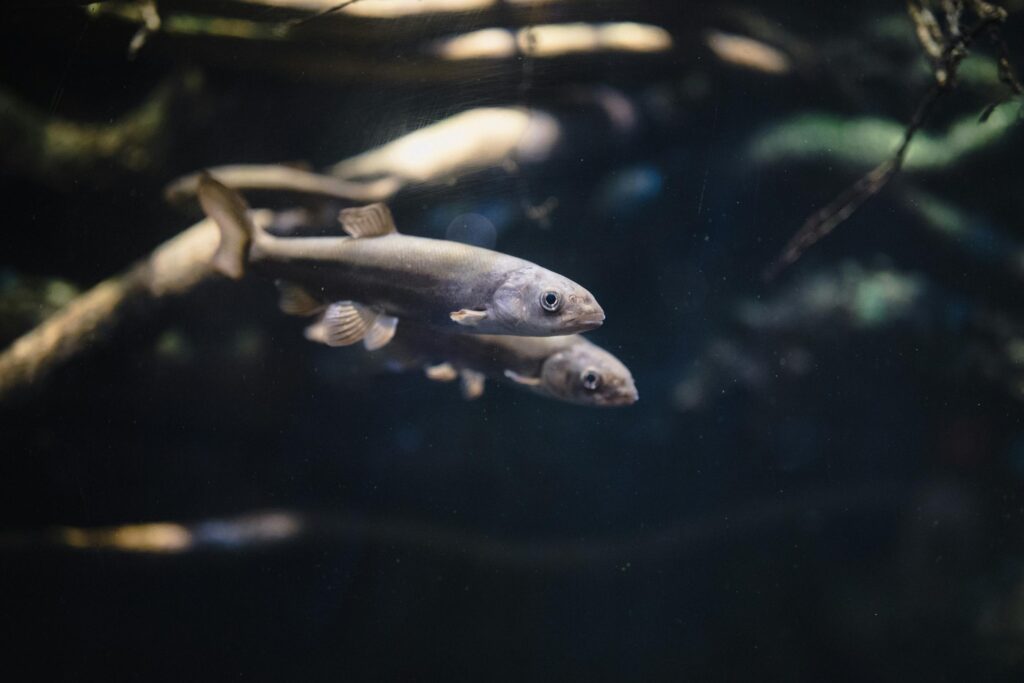
The aquarium in Singapore is a cavern of recycled cool air, offering a sharp and welcome contrast to the suffocating humidity waiting just beyond the exit doors. I sit on a carpeted bench in the dim blue glow of the main viewing tunnel. The space smells faintly of ozone and damp canvas. All around me is a low, collective murmur of school groups and echoing footsteps. I press my hand against the cold, thick acrylic. On the other side, silver flashes dart through the water. It is hard to tell who is watching whom. We stand in the dark, peering into the light, while the fish drift past with a slow, indifferent grace, treating us as nothing more than shadows on the edge of their world.
My aunt used to tell a story about two silver fish. She would sit at her kitchen table, tracing the rim of her teacup with her index finger, her voice dropping to a theatrical whisper. According to her legend, there were once two lovers who belonged to warring villages. When they were discovered, they ran to the edge of the sea. The ocean took pity on their devotion and pulled them into the waves, turning them into two silver fish so they could swim side by side forever, untouched by the cruelties of the land. I knew even then that it was a fairy tale, but I loved the way her eyes softened when she told it.
As I grew older, I realized the story was never really about ancient villagers. It was always about her and my uncle. They were entirely different creatures. He was a quiet man who worked with his hands, and she was a hurricane of vibrant dresses and loud laughter. Yet they moved through life in perfect, unspoken synchronization. I watch a pair of silver trevally mirror each other’s movements through the water, darting left and right in absolute tandem, and a familiar ache settles in my chest. I would give a great deal to hear her tell that story just one more time.
“They never leave each other.”
The voice belongs to a little boy sitting cross-legged on the floor beside my bench. He is perhaps six years old, wearing a bright yellow raincoat that crinkles loudly when he shifts his weight. His small finger traces the path of the two silver trevally I had just been watching.
“They do not,” I reply softly, leaning forward. “Do you know why?”
He shakes his head, his eyes wide and glued to the glass.
“Because they used to be people,” I tell him, keeping my voice gentle and conspiratorial. “They were two people who loved each other very much, but they could not be together on land. So the sea turned them into fish. Now they get to explore the whole ocean together.”
The boy turns his head to look at me, weighing the truth of my words. Then, with the easy acceptance only a child can muster, he nods. He presses a small, sticky hand against the glass right where the two fish pass by, a silent greeting to the enchanted lovers. His small gesture of belief lightens something heavy in my ribs.
We are all enclosed in our own lives, separated by thick glass from the people swimming past us. Yet, every so often, the glass thins. We press our hands against the barrier and manage to share a story, a moment, a breath of shared air. The boy’s mother calls his name, and he scrambles up, his yellow coat crinkling as he runs down the tunnel. I remain on the bench, watching the two silver fish turn seamlessly together, disappearing into the deep blue gloom.