
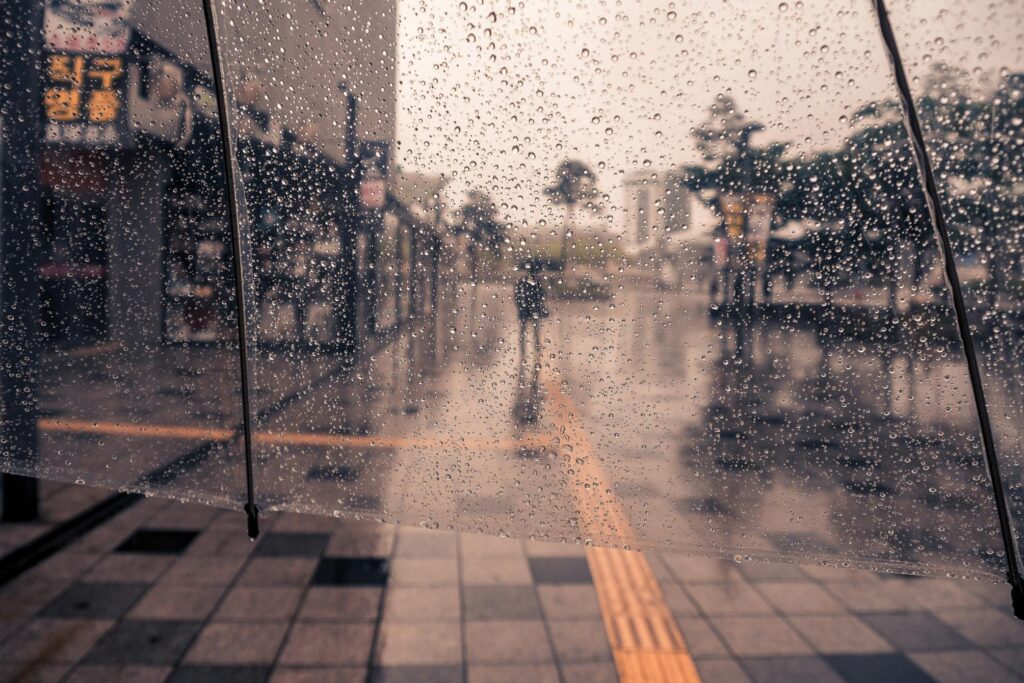
The monsoon rain in Seoul does not just fall; it claims the city. I had just navigated the steep, slick stairs of the Jongno-3-ga subway exit when the sky finally broke, forcing me under the narrow canvas awning of a GS25 convenience store. The air smelled of wet concrete and the sharp, comforting spice of simmering tteokbokki from a nearby street cart. I stood near the glass doors, listening to the electronic chime every time a customer entered, feeling the familiar, heavy solitude that often accompanies traveling alone in bad weather.
I was not the only one seeking refuge. A few feet away stood a young Korean woman, perhaps in her early twenties, holding a transparent vinyl umbrella. She had it tilted back slightly, resting on her shoulder. The clear plastic caught the bleeding red and blue neon lights from the karaoke bar across the street, illuminating her face in soft, shifting colors. When a passing delivery scooter sent a shallow wave of puddle water toward the curb, I stepped back quickly, knocking my shoulder against the glass. She noticed, offering a polite, sympathetic smile, and took a small step sideways to give me more room beneath the dry center of the awning.
“It is coming down hard,” I said, gesturing to the street, surprised by my own impulse to speak.
She nodded, looking out at the flooded asphalt. “It will stop soon. I am just waiting.“
She checked her phone screen, the bright white light reflecting in her dark eyes. There were no new messages. Without looking up, she let out a slow breath. “I am waiting for him,” she added, her voice barely louder than the drumming rain. “I told him I would be near the station.”
I asked if he was running late.
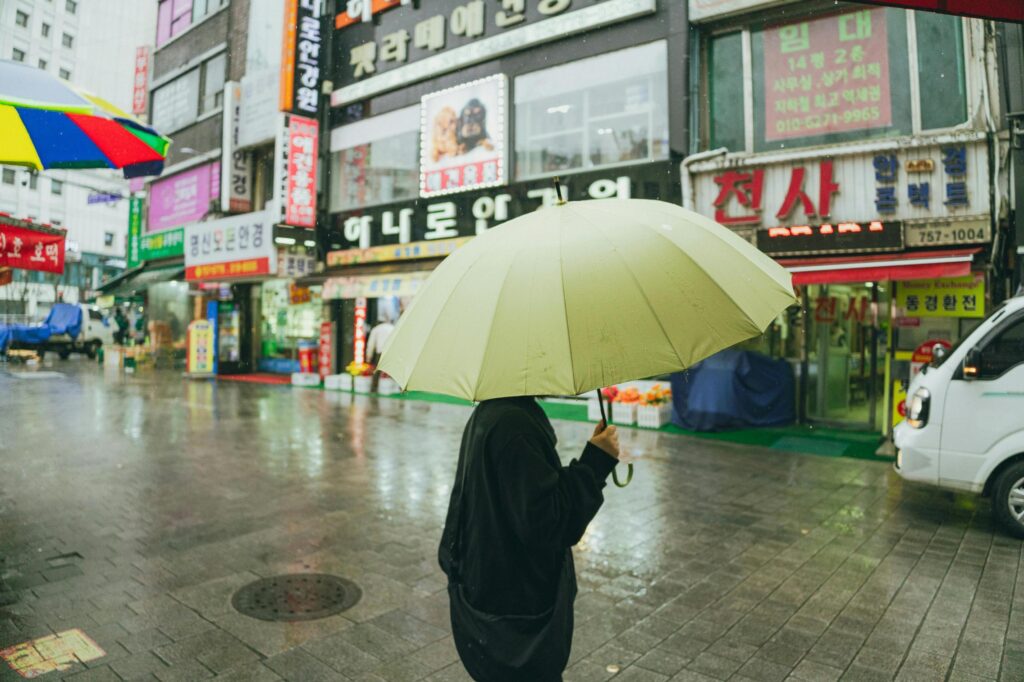
She shook her head, finally looking at me. “No. We are not together. Not yet.” She spun the handle of her clear umbrella, sending small droplets flying onto the pavement. “He does not feel the same way right now. But I think he will. So, I am waiting for him to love me back.”
The raw, unpolished honesty of her confession caught me entirely off guard. In my own life, I have always treated unrequited love as a signal to pack my bags and run. I have always viewed waiting as a form of weakness, a failure to protect my own heart. Yet, standing next to this stranger, I saw no weakness. There was a quiet, staggering bravery in her posture. She was standing in a storm, fully exposed to the cold reality of her situation, yet choosing to stay.
Her transparent umbrella felt like a physical manifestation of her heart: fragile-looking but remarkably resilient, allowing her to see the gray skies clearly while keeping the worst of the cold at bay. She was simply, patiently, waiting for the rain to pass.
A few minutes later, the heavy downpour reduced to a fine, misty drizzle. The girl gave me a brief bow of her head, opened her clear umbrella fully, and stepped out from under the awning. I did not ask what she would do if he never showed up, or if the waiting would eventually break her.
I just stood by the convenience store window, watching the neon lights warp through the plastic dome of her umbrella until she disappeared into the crowded, wet streets, wondering what it takes to be that certain of anything.