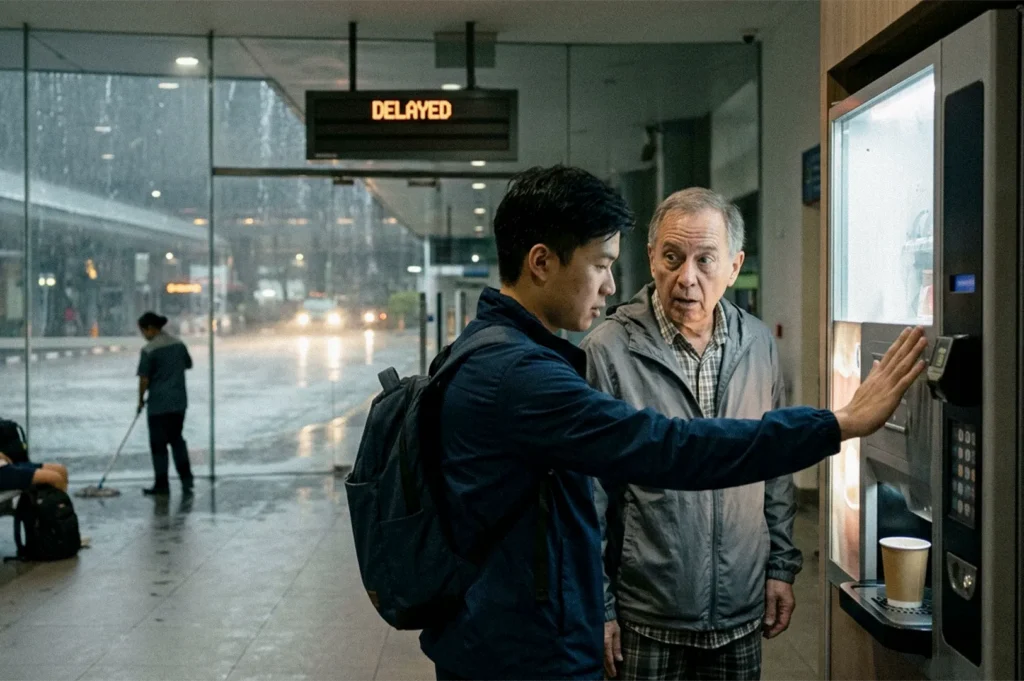
The departure board said DELAYED in orange letters. Then it stopped saying anything at all.
It was 2 a.m. Rain hammered the terminal roof so hard it sounded like gravel being poured. Outside, the bus bays had turned into shallow rivers. Inside, there were four of us: a cleaner pushing a mop in slow arcs, a teenager asleep on his backpack, me, and a man in a gray windbreaker standing very still in front of the vending machine.
I had two bags, a new job in a city I’d visited once, and a phone full of goodbye messages I hadn’t answered. My mother’s last text said Eat something. I hadn’t.
So I went to the machine too.
He was pressing the coin return. Gently, then less gently.
“It took my money,” he said. He didn’t sound angry. He was just reporting. “Didn’t even say thank you.”
I knew this kind of machine. My old office had one just like it, moody in the same way. I pulled the return lever and gave the side panel a flat-palmed thump just under the coin slot. Something rattled. The coin dropped into the tray.
He looked at me like I’d done a card trick. “Where’d you learn that?”
“Six years of bad office coffee.”
He fed the coin back in, slowly this time. A paper cup dropped, the machine hummed, and steam curled up. He bought mine too. I didn’t argue.
We sat on the metal bench by the window. The hot chocolate was too hot to hold, so I held it by the rim. It tasted mostly of sugar and powdered milk. It was exactly right.
His name was Walt. He’d driven buses for thirty-four years, city routes first, then overnight long-haul. He retired in the spring.
“First time I’ve ever sat in the back,” he said, nodding at the dark bays. “Feels like cheating.”
He was going to see his daughter. She’d moved away eleven years ago. He’d meant to visit every year. Then there’d be a shift to cover, a route change, a winter.
“You think there’s always next month,” he said, turning the cup in his hands. “Lots of next months.”
He said it plainly and moved on, the way you’d mention the weather.
When I told him about the job, he didn’t tell me I’d be fine. He asked which seat I’d booked.
“Fourteen.”
“Swap if you can. Left side, middle rows. Less sway than over the back wheels, and you won’t get the door draft every stop.” He tapped my bag. “Keep a jacket on top. Drivers keep it cold to stay awake.”
“So you were the one freezing everyone.”
“Guilty.”
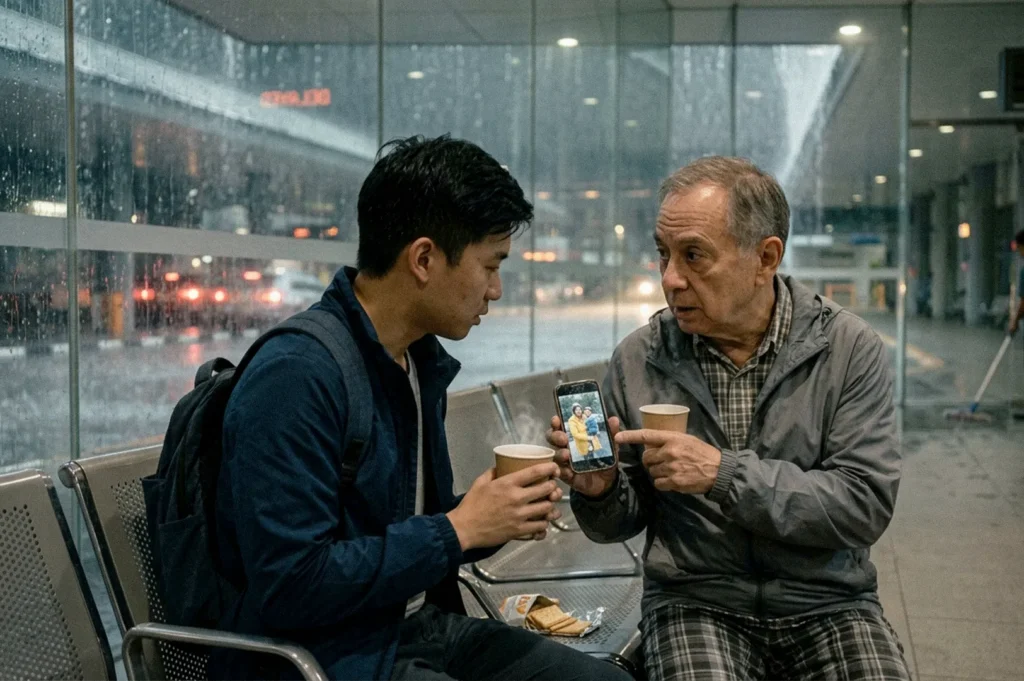
He showed me a photo on a cracked phone. A woman in a yellow raincoat, squinting, holding a toddler. “Grandson. Haven’t met him yet.” He put the phone away quickly, as if it might get wet.
I gave him half the crackers from my bag. He ate them carefully over his palm, catching the crumbs.
The rain softened. The lights outside became blurs of red, white, and amber, like a painting that hadn’t dried.
I’d been treating this move like something to survive. A door closing behind me. Walt had spent his whole life carrying people toward somewhere. Some of them must have been just as scared. They’d arrived anyway.
At 3:40, my bus pulled in, wipers working hard, headlights sweeping across the wet floor.
Walt stood and looked at the driver through the windshield, the way you’d look at an old colleague. He raised a hand. The driver raised one back, not knowing why.
“Left side,” Walt said.
“Middle rows.”
His bus was later, heading north. I climbed aboard and found a seat on the left.
Through the fogged window, I watched him settle back onto the bench, small under the terminal lights. He was peeling the lid off a second hot chocolate he must have bought when I wasn’t looking.
The bus pulled out. I put on my jacket.