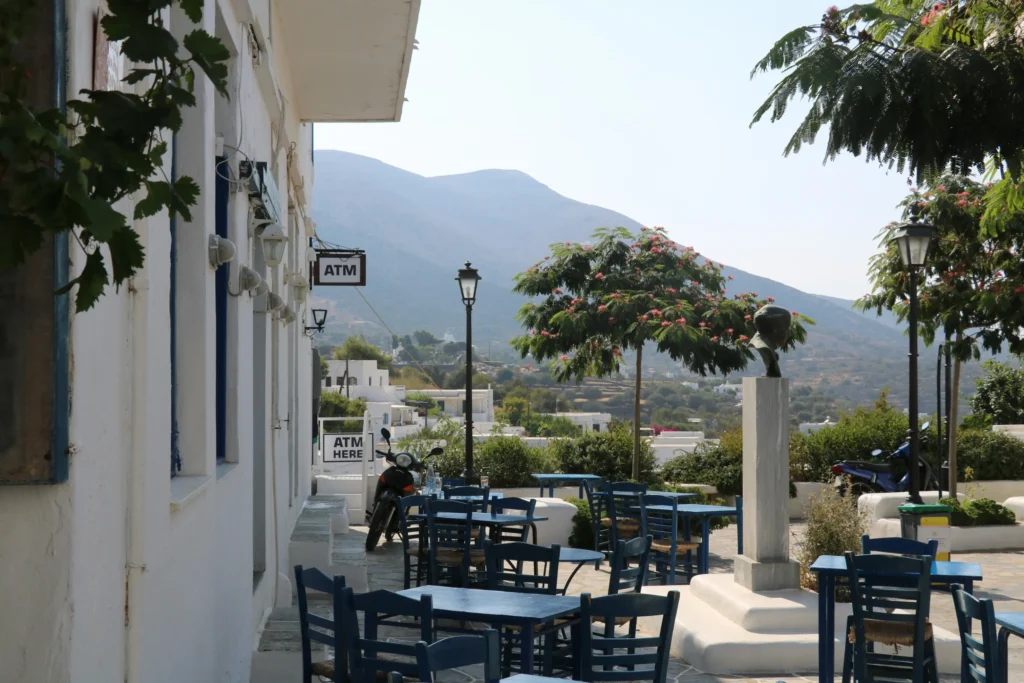
The heat followed me inside, the way it does in Greece; thick and golden, clinging to the back of my neck even after the door swung shut behind me.
I’d come in for the film, and the air. Someone had told me this little cafu00e9 played movies for whoever wandered in, and I’d walked half the afternoon on stone streets with the sea flashing between buildings, sugar still on my lips from a pastry I’d eaten too fast. I wanted Mamma Mia. I wanted the bright noise of it, the singing, the mothers and daughters getting it wrong and then getting it right.
But Mamma Mia wasn’t playing.
Lady Bird was.
I almost left. Then I ordered a coffee instead (served small and strong, the cup warm in both my hands) and sat near the back, where the projector hummed its low, steady hum and threw its light across a wall gone soft with age.
I should have known better. Some films find the wound without asking.
There was a woman beside me. Older, alone, a plate of something half-finished in front of her. We hadn’t spoken. That’s the strange thing about a room like that; you sit close enough to feel the warmth of a stranger’s arm, and still the distance between you stays wide as the sea outside.
Then the scene came.
What if this is the best version?
I closed my eyes. It’s a small thing, closing your eyes in a dark room, but I did it to keep something in. Because the thought arrived whole, the way the worst thoughts do: what if this is my best version? What if my mother spends her whole life waiting for a better me u2014 a kinder, quieter, easier daughter u2014 and is disappointed to the end, because this is it. This is all there is.
I held my breath. The fan turned somewhere. A cup clinked. Outside, tourists laughed at something that had nothing to do with me.
I felt her hand before I understood it. The woman beside me, tucking a strand of hair back behind my ear; a gesture so ordinary, so maternal, that it undid me faster than the film had. Then she pulled me in. Just held me, this stranger, in a cafu00e9 that smelled of coffee and warm stone.
u201cYour mom sees the person you are now,u201d she whispered into my hair. u201cThe person she prayed for, the person she watched grow, the person she loves more than anything. I know she is so proud of you.u201d
u201cSometimes mothers donu2019t say the things we should. Sometimes we think our love is obvious, so we forget to put it into words. But we see. We always see. And your mom has never stopped seeing you.u201d
I didn’t answer. I couldn’t.
I sat with it after she let me go, both of us turning back to the wall as if nothing had happened. And I turned the sentence over in my hands. It didn’t fix anything. My mother and I were still what we were; that old, unhealed thing between us, tender in all the wrong places. But the woman had offered me a different possibility. That being seen and being told are not the same. That maybe I had been listening for words all along, when the seeing had been happening quietly, out of my sight.
Maybe. I don’t know. I still don’t.
The film kept playing. The cafu00e9 noise returned around me like water.
When I finally stepped outside, the light was everywhere; bright, indifferent, kind. I folded her sentence up small and put it somewhere I could reach later.
Then I walked back toward the sea.