I arrived before the village was awake.
The cobblestones were still damp from the night, and my footsteps were the loudest thing on the lane. Somewhere above me, a shutter creaked open. A woman leaned out, said something soft in the local dialect to no one I could see, and pulled a window box of geraniums closer to the light.
Then the smell found me. Butter and warm yeast, drifting up from a bakery whose lights had just flickered on. I followed it the way you follow anything that feels like a memory you haven’t made yet.
This is the hour Alsace keeps for itself.
Before the Village Began to Sing
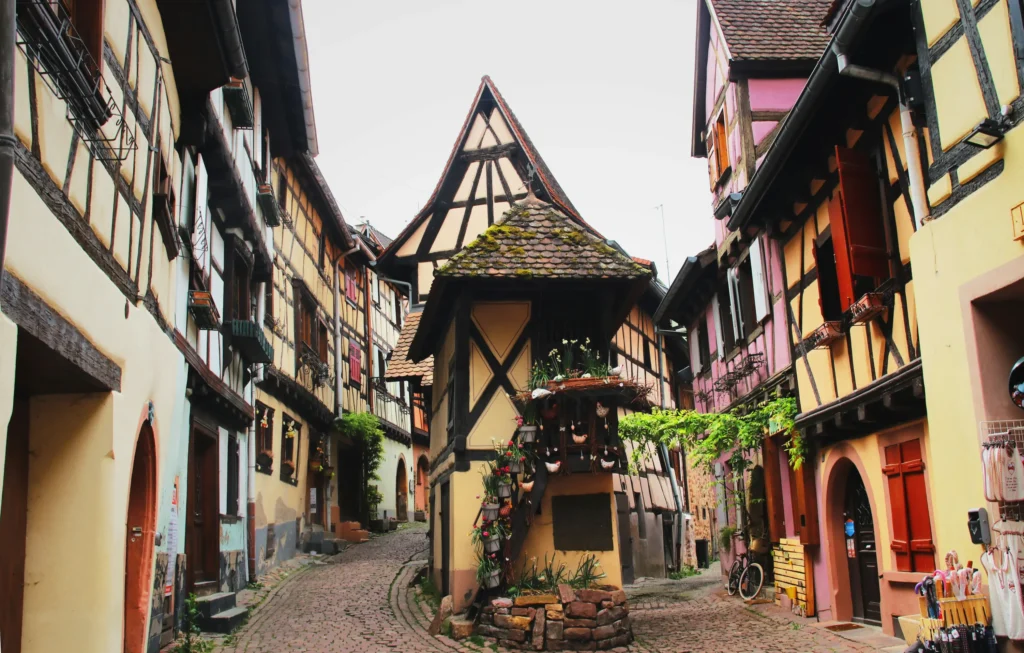
If you come, come early. The tour buses arrive by late morning, and they have their own kind of joy, but the village belongs to the early walker first.
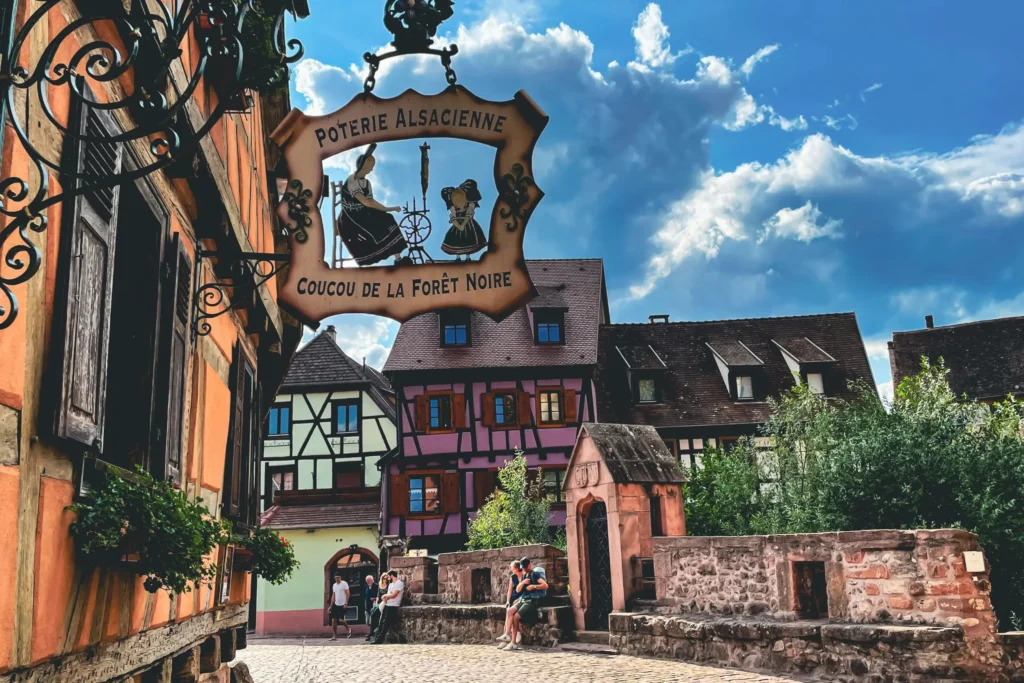
Riquewihr is small enough to hold in your hands. The houses lean toward each other across narrow lanes, timber frames dark against walls painted in soft sherbet shades: faded apricot, dusty rose, a yellow like the inside of a pear. Crooked rooftops tilt at angles no modern builder would allow. Painted shutters hang slightly uneven, and somehow that’s the point.
Geraniums spill from nearly every window box, red and pink against the old wood. Not staged. Just tended. You can tell the difference. These are flowers someone waters before breakfast, not props arranged for a photo.
I walked slowly, which is the only honest way to walk here. The lanes curl rather than run straight, so the village reveals itself a little at a time; an old hanging sign here, wrought iron shaped like a bunch of grapes; a wine shop there, its door not yet open; a fountain worn smooth by centuries of hands.
There’s a moment, turning one of those bends, when the whole street opens up ahead of you; flower boxes, leaning gables, a girl on a bicycle gliding through the quiet. I understood then why a certain animated village feels so familiar to anyone who grew up on it. It isn’t that Riquewihr looks like the cartoon. It’s that the cartoon was reaching for a feeling that lives here, plainly, every morning.
I let that thought pass and kept walking. The real thing doesn’t need the comparison.
A Pastry Warm Enough to Remember
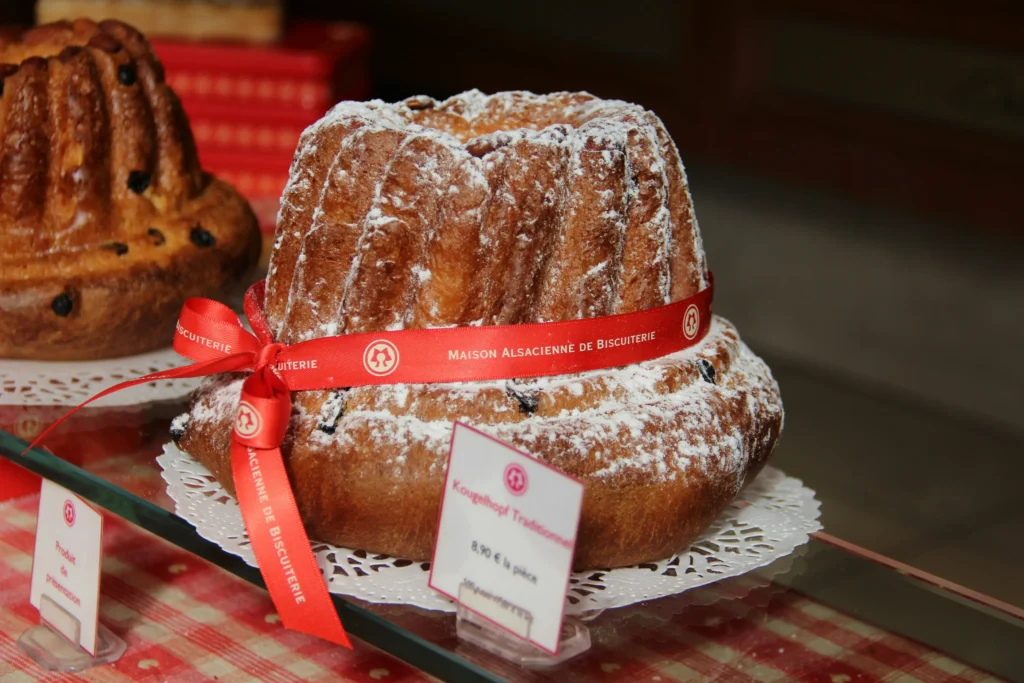
The bakery was open by then.
I bought a slice of kougelhopf, that tall ring-shaped Alsatian cake studded with raisins and almonds, dusted so heavily with sugar it clung to my fingers and the corner of my mouth. It was still faintly warm. Buttery in the way that asks nothing of you; not rich, not heavy, just gentle.
I ate it standing in the café’s narrow doorway, watching the village wake. A man wiped down two outdoor tables. The coffee machine hissed behind me. No music, no rush. Just the small sounds of a place beginning its day.
You should know: the kougelhopf you buy from a village bakery in the morning tastes different from any you’ll find later, anywhere else. I can’t fully explain it. Maybe it’s the quiet you eat it in.
Afterward, I ducked into a small shop tucked inside one of the timber-framed houses. Inside, the ceiling beams were low enough to touch. The shelves held local pottery, heavy stoneware glazed in deep blues and earthy browns, the kind meant for baking, not display. The woman behind the counter let me look without hovering. I bought one small dish. It sits on my kitchen counter now, holding salt.
Between Vineyards and Painted Houses
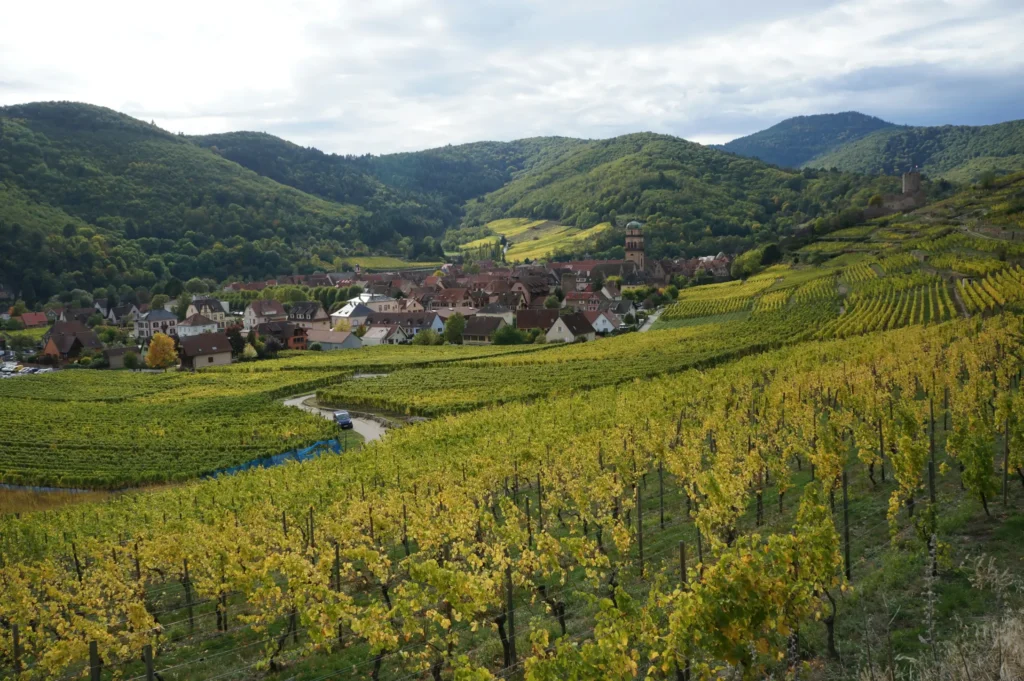
A car helps here. Truly. The villages of the Alsace Wine Route sit close together, threaded along the foot of the Vosges hills, and the joy is in moving between them slowly, on your own time.
The drive from Riquewihr to Ribeauvillé takes only minutes, but I stretched it. Vineyards rolled up the slopes on either side, the vines lined in neat green rows that turned and followed the curve of the land. The light was higher now, warmer. A tractor crossed the road ahead of me, unhurried, and I waited without minding.
Anticipation has a flavor, I think. It tasted a little like that morning’s sugar, still on my lips.
Ribeauvillé: The Village That Lived Beyond the Fairytale
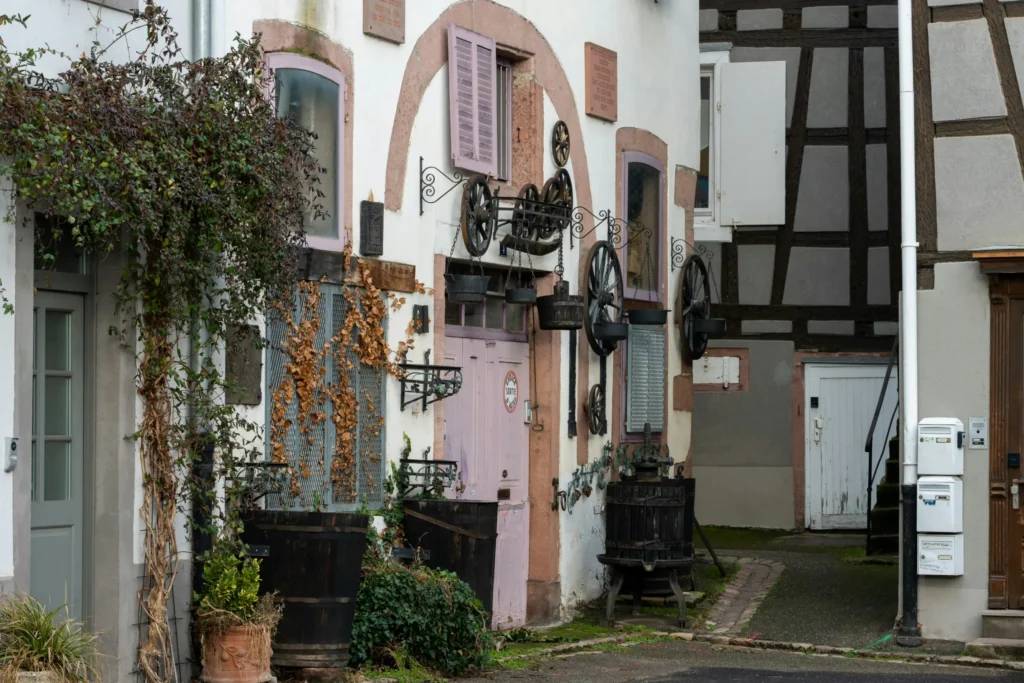
Ribeauvillé is Riquewihr’s companion, not its copy. It’s a touch larger, a touch more lived-in. The half-timbered houses are here too, the flower boxes, the painted shutters, but so is the everyday. A pharmacy with its green cross glowing. School children crossing the main street. An older man reading a paper outside a café, nodding to people he clearly sees every day.
I liked it for that. The fairytale here doesn’t perform. It just exists alongside ordinary life, the way old things do when people never stopped living among them.
Above the village, the ruins of three castles sit on the wooded ridge, watching over the rooftops the way they have for centuries.
A Glass From the Hills
By midday I found a small wine cellar, its heavy wooden door propped open to the street. Inside, the air was cool and smelled of oak and something faintly mineral. The walls were stone, the bar a slab of dark timber worn pale at the edges. A man poured me a glass of Riesling without much ceremony, dry, bright, a little flinty, the kind of wine that tastes of the hills I’d just driven through.
“From here?” I asked, nodding at the bottle.
“From there,” he said, tilting his head toward the window, toward the slopes.
That was the whole conversation. It was enough. I sat with the glass for a while. Outside, a tour group had arrived, voices rising in the lane. Inside, it stayed quiet. There’s a lesson in that, maybe; that the good moments are often just one door away from the busy ones.
When the Shutters Turned Gold
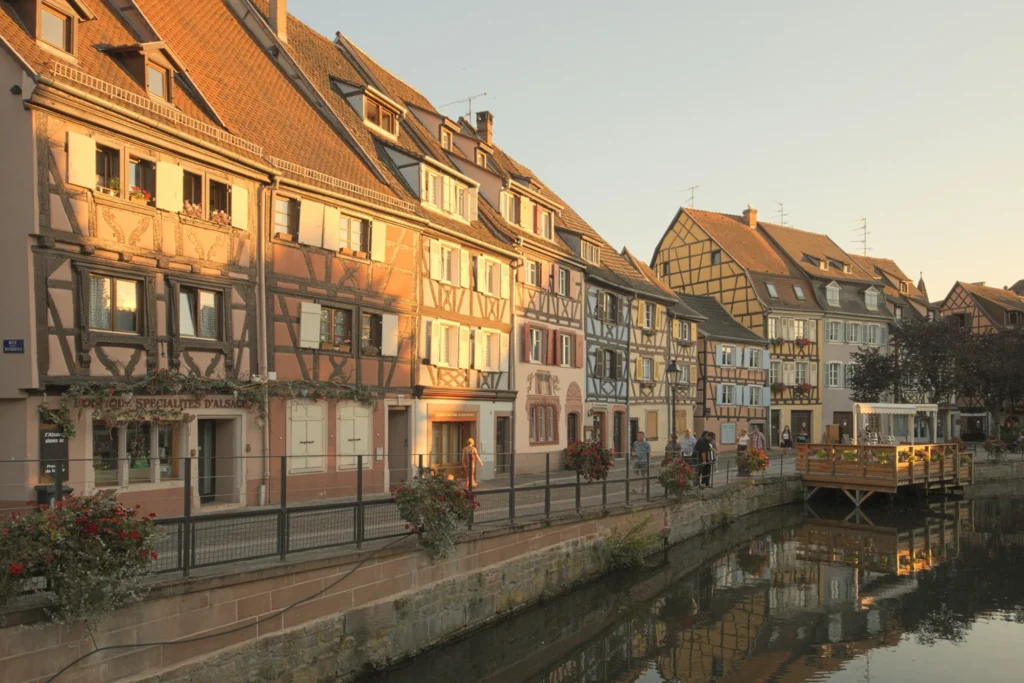
I stayed until the light turned. This is the part no one can sell you, and the part worth waiting for. As the afternoon softened toward evening, the villages turned amber and honeyed. The pale walls glowed. The timber frames deepened to warm brown. The flower boxes burned a final, vivid red before dusk.
The day-trippers had mostly gone. The lanes emptied again, the way they’d been at dawn, and the village exhaled. I walked one last loop through Riquewihr as the shutters began closing for the night, the same soft creak I’d heard that morning, now in reverse.
The Magic Was in the Slowing Down
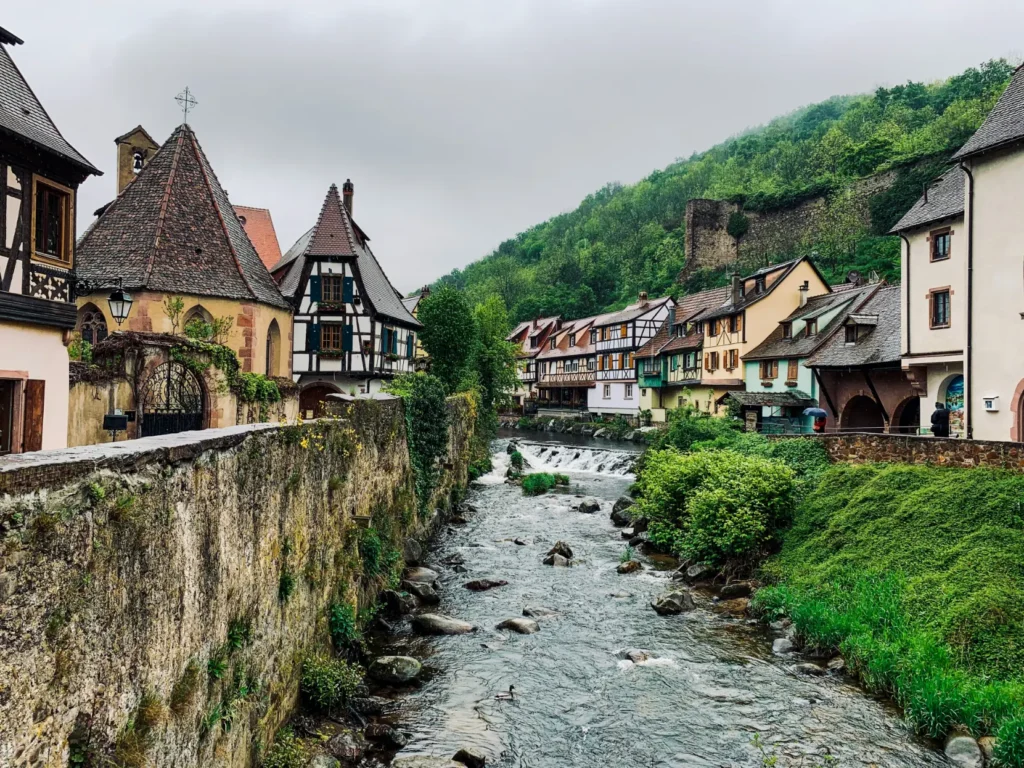
If you come (and I hope you do) come in late spring, when the geraniums are heavy and the vines are green. Or come in December, when the Christmas markets fill these same lanes with woodsmoke and mulled wine and small wooden stalls. Both are their own kind of magic.
But whenever you come, walk slowly. That’s the only real advice I have.
Because the magic of Alsace was never in one perfect square or one famous façade. It was in the rhythm: the morning bread, the unhurried road, the cool cellar, the light going gold. It asks only that you slow down enough to notice it.
To have a full look on different fairytale-like places, visit our article: Once Upon a Passport: Real Places That Feel Like Disney. And if you still have it in you, bring your passport along and have a knack on our take the best Japanese restaurants in Singapore!