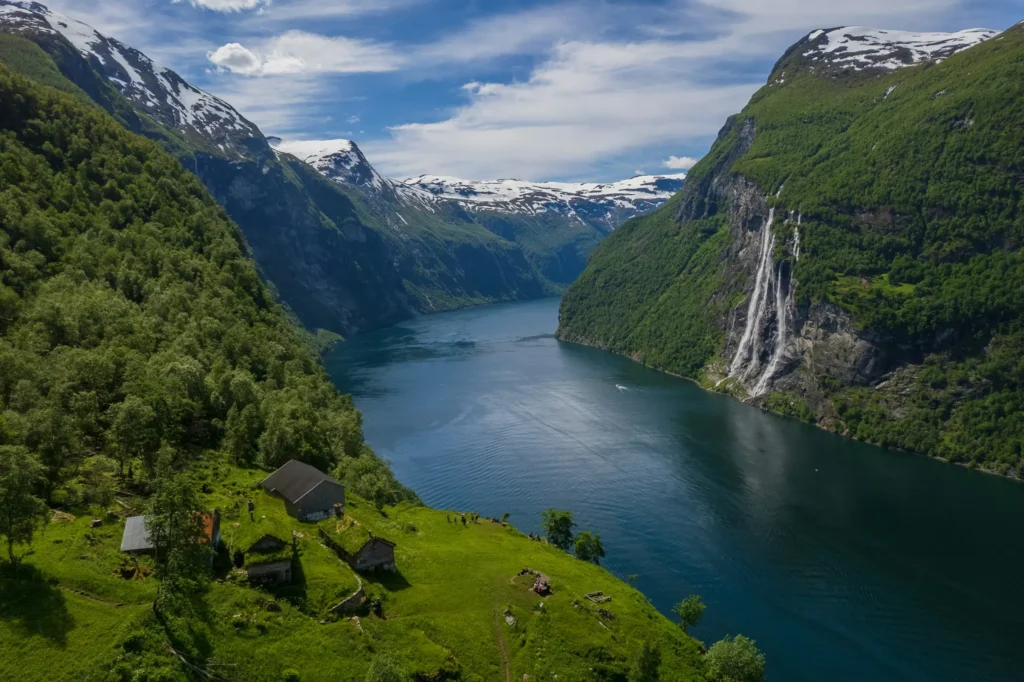
The first thing the fjord gave me was the cold.
Not a sharp cold. A clean one. It came in through the open car window as the road dropped down toward the water, and I breathed it all the way into the bottom of my lungs; wet stone, pine, something faintly green, like moss after rain. The kind of air that makes you feel newly awake, even after a long drive.
Then the valley opened, and I forgot to keep talking.
The Road Down to Dark Water
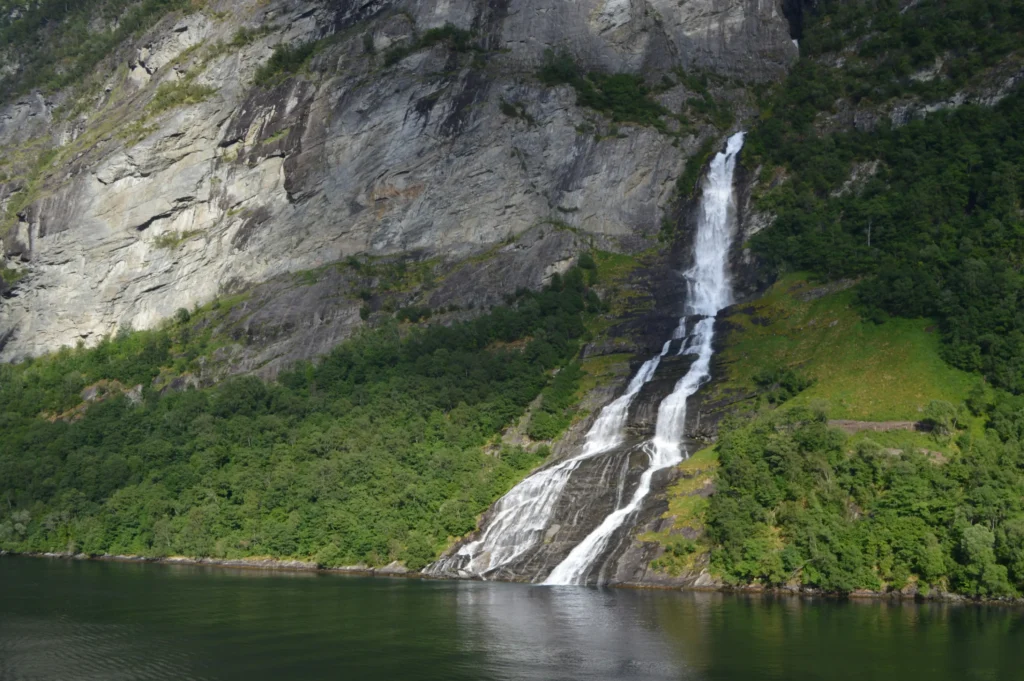
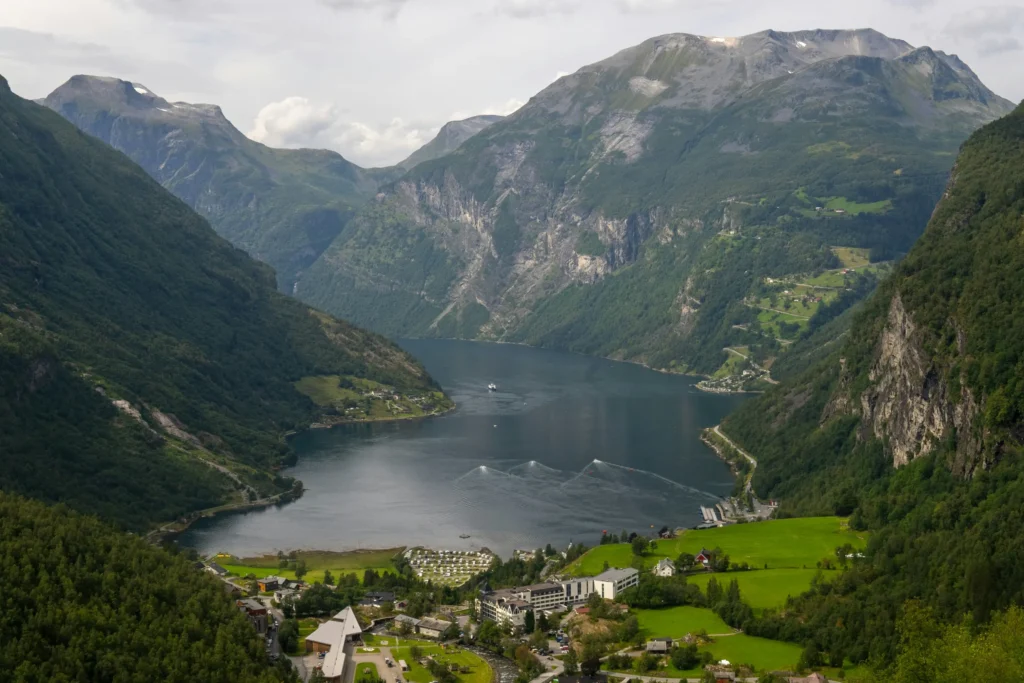
I came by road, which I’d recommend if your stomach can take the bends. The descent into Geiranger is a slow unspooling of switchbacks, each turn handing you a little more of the view, until the fjord lies below you like dark glass between walls of green.
The water was deep blue, almost black where the cliffs leaned over it. The cliffs themselves rose straight up, sheer and impossible, their tops dusted with snow even in summer. Somewhere far below, a single boat cut a thin white line across the surface and looked no bigger than a thread.
I have stood under tall buildings before. This was different. This was the kind of scale that doesn’t impress you so much as quiet you. I felt small the way you do in an old cathedral, not diminished, just gently put in your place.
It’s worth saying: come in summer. The daylight stretches long here, and the weather is kinder. I had read that, planned around it, and still wasn’t ready for how the light behaved. More on that later.
Where the Seven Sisters Fell
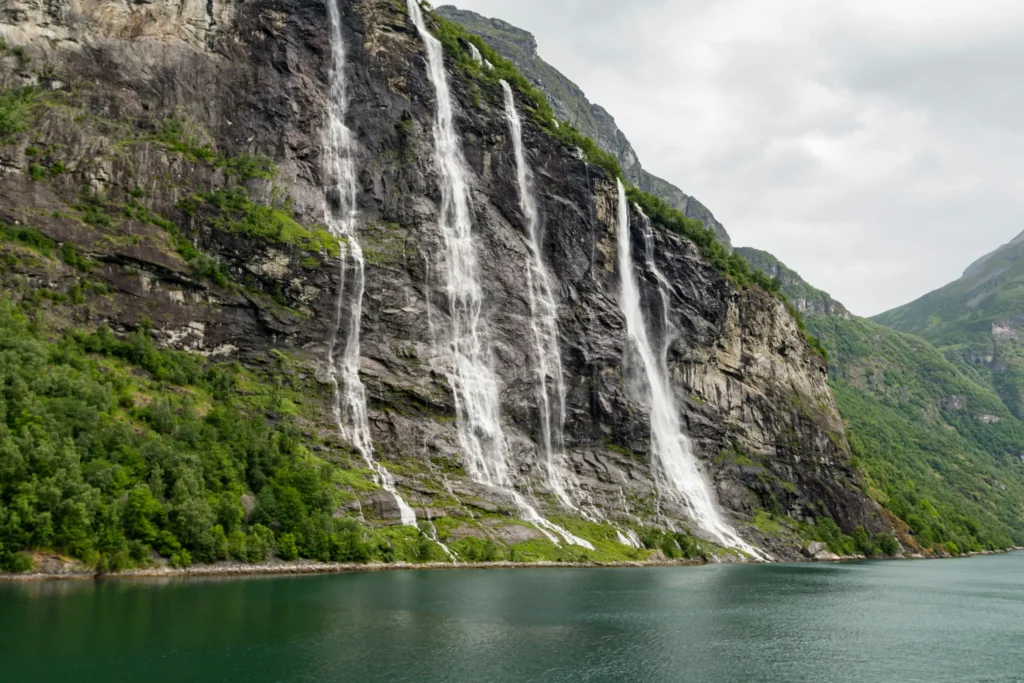
The next morning I took the fjord cruise, and this is the part I’d tell you not to skip. You can see Geirangerfjord from above, and it’s magnificent. But on the water, the scale rearranges itself around you. The cliffs stopped being scenery and became walls; close, towering, streaked dark with old runoff. The boat felt like a leaf. My coffee went cold in my hands because I couldn’t stop looking up.
The damp came off the water in a fine mist, settling on my jacket, on my eyelashes. Gulls turned somewhere overhead. And then I heard it before I saw it… a low, steady roar building against the engine’s hum.
Seven separate falls, threading down the rock face side by side, white against the wet black stone. From a distance they looked delicate, almost still, like silver threads someone had hung against the cliff. Up close, the sound changed everything. The roar filled the whole valley. The mist drifted out across the water and touched my face, cold and surprisingly soft.
Somewhere in the back of my mind, a familiar tune stirred; that animated kingdom of ice and fjords that so many of us carry from childhood. I let the thought arrive and let it go. The drawings had reached for something. This was the thing itself, older and wetter and far louder than any song. You don’t narrate a place like this. You just stand in it.
Eleven Bends Above the Valley
If the cruise humbled me gently, Trollstigen did it with my heart in my throat.
I drove it the following day, eleven hairpin bends climbing a near-vertical mountainside, the road folding back on itself again and again. A waterfall crashed down the cliff alongside it, loud enough to hear over the engine, throwing spray across the asphalt.
I won’t pretend I was calm. My hands were tight on the wheel. At each bend the valley fell away beneath me, further and further, until the cars below looked like beads scattered on a ribbon. Clouds shifted across the peaks, hiding them, then handing them back.
At the top, I parked and walked out to the viewing platform on shaking legs. The wind up there had teeth. But the whole road lay below me, a mad green tangle of switchbacks, and beyond it the land rolled out in ridges and snowfields as far as I could see.
I stood there longer than I meant to. Nobody spoke much. There’s a particular kind of silence that strangers keep together when something is too big for small talk.
The Hour the Fjord Held Its Breath
My favorite moment wasn’t loud at all. On my last full day (and I’d give the fjord two or three days, truly, it isn’t a place to rush) I took a short hike up above Geiranger village. Nothing heroic. Just a path through low brush and damp moss, my boots squelching, the air smelling of earth and cold water.
Then the trees thinned, and the valley simply opened.
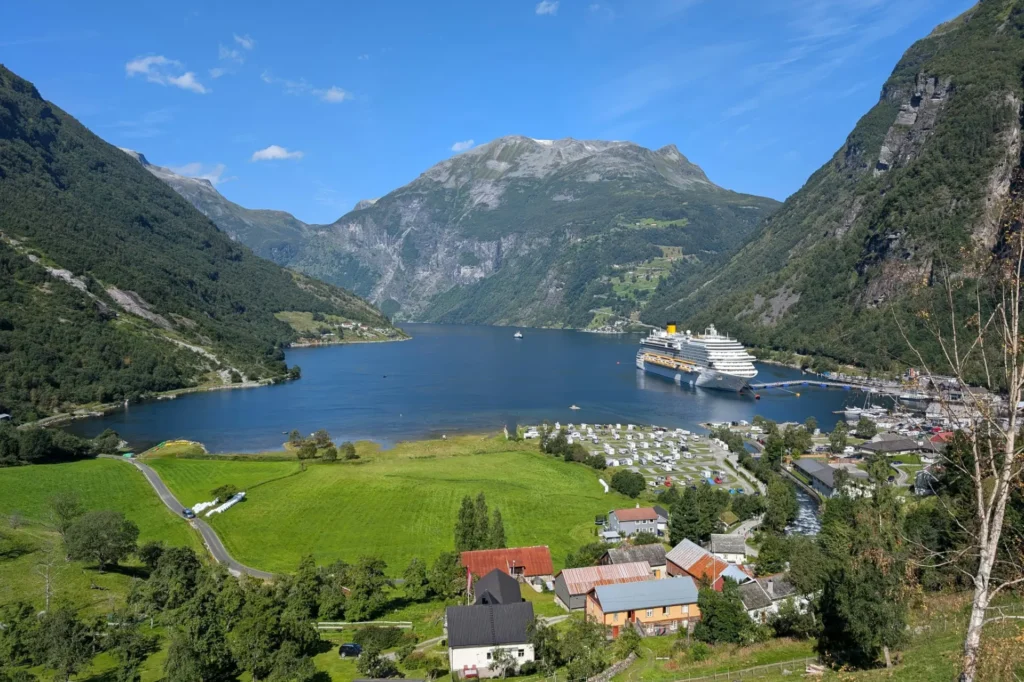
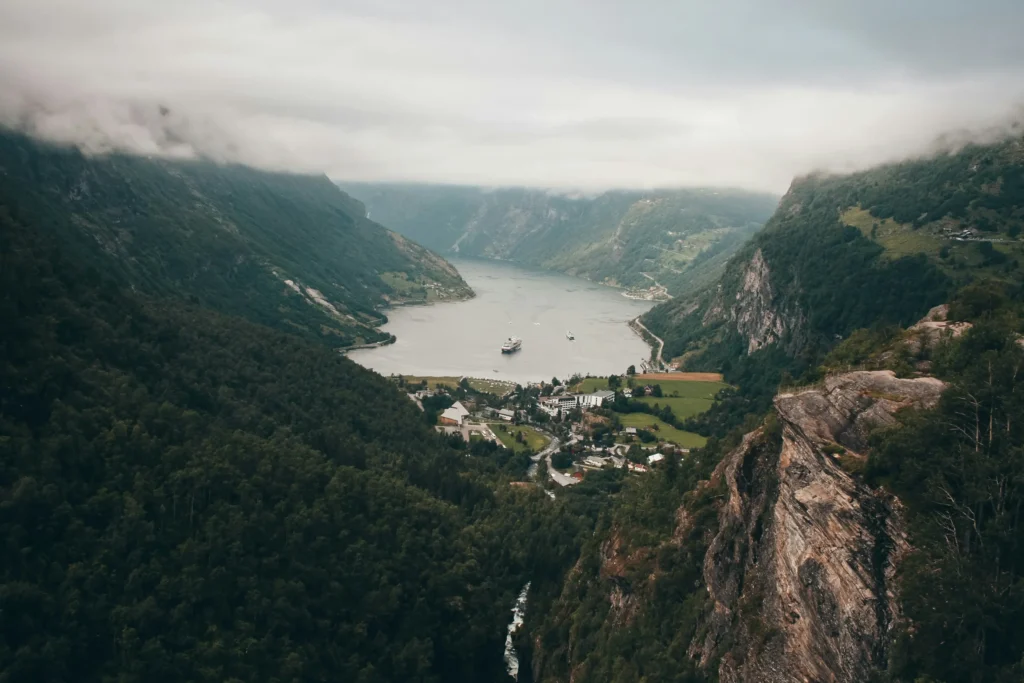
The fjord lay below in its long dark line. A few red cabins clung to the green slopes, smoke rising thin from one of them. The snowline sat high and white above. And the water held all of it (the cliffs, the sky, the drifting clouds) like a mirror someone had laid flat between the mountains.
I sat down on a rock and didn’t take a photo. I wanted to, reached for the phone, then didn’t. Some things you keep by being present for them instead.
This was the evening light everyone talks about, and now I understand why. It doesn’t fall here so much as linger. The sun stays low and golden for hours, refusing to set, gilding the rock faces and turning the water to bronze. Time felt suspended. Day and dream blurred into one long, glowing breath.
Soup, Bread, and the Warmth After Wonder
Cold gets into your bones up here, even in summer. So I came down to the village and found a small place near the water, windows fogged at the edges, and ordered fish soup and bread.
The soup arrived steaming, pale and creamy, dense with soft chunks of fish and a sweetness from the cream and the sea. The bread was warm, the crust giving way to a soft middle, perfect for soaking up what the spoon couldn’t catch. I tore it by hand. I ate slowly.
Outside the fogged glass, the fjord kept glowing. Inside, my hands warmed around the bowl. There’s a particular comfort to eating something hot and simple after a day spent feeling small against something enormous. The soup didn’t try to be clever. It just put me back together.
The Smallness That Stayed
I came to Geirangerfjord half-expecting a postcard or just a fairytale sort of attraction, a pretty place, photogenic, easy to love and easy to leave.
What I found was wilder than that. Taller, colder, louder. A landscape that doesn’t perform for you and doesn’t need to. The waterfalls were falling long before anyone came to watch them, and they’ll keep falling long after.
If you go, come in summer for the light. Stay a few days. Take the boat out among the cliffs. And give yourself one quiet hour, somewhere high, where you do nothing but look.
You’ll feel small there. But it’s the best kind of small, the kind that makes room inside you for something larger.
I’m still carrying it. I think I will for a while.