
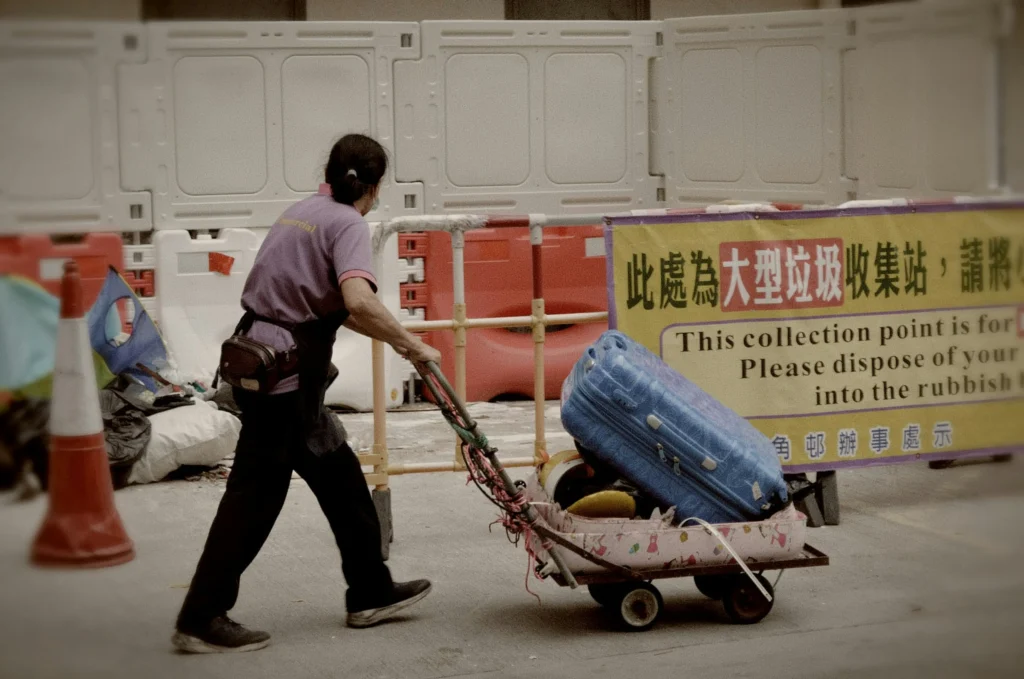
The carousel kept turning long after everyone else had gone.
I stood under the cold white lights of the Hong Kong arrival hall, watching black bag after black bag slide down the belt and circle past me. Announcements rolled out in Cantonese, then English, then back again. The air-con bit through my jacket. Somewhere a coffee machine hissed, and underneath it all sat that faint airport smell: jet fuel, floor cleaner, the tiredness of strangers.
I checked the tag in my hand again. The barcode. The flight number. I already knew.
Nemo was gone.
Bright blue, scuffed at the corners, one wheel that squeaked since 2019. He wasn’t on the belt. He wasn’t in the oversize area. The staff member was kind, scanning, typing, telling me they’d look. I nodded. I said thank you. And then, standing there alone by a stranger’s forgotten stroller, I started to cry.
Not the pretty kind. The kind you try to swallow back and can’t.
I was embarrassed. A grown woman crying over a suitcase. I turned toward the wall, wiped my face with the back of my hand, told myself it was just luggage, just clothes, just things you can replace.
That was when I felt a small tug at my sleeve.
A little girl. Maybe six. A bob cut, a too-big backpack, one sock slipping down. She looked up at me with the serious face children make when they’ve decided to be brave.
“You’re sad,” she said. Not a question.
I crouched down. “A little.”
She held something out in her closed fist, then opened it. A keychain — Nemo, the actual fish, small and rubbery, the orange paint chipped on one fin. From the vendor by the windows, I guessed. The clasp gave a tiny click as she pressed it into my palm.
“I have two,” she said, very matter-of-fact. “You can keep this one. So you’re not lost.”
So you’re not lost. As if she knew the suitcase’s name. As if she knew anything at all.
I closed my fingers around it.
My grandmother gave me Nemo when I was twelve. We were on the sofa, the fan clacking in the corner, the movie playing on the old TV, the part where the little fish gets carried out to the open ocean. She laughed at the seagulls. Mine, mine, mine. She laughed so hard she had to put her tea down.
Afterward she handed me the blue case, still wrapped. “For when you go far,” she said. “So you remember the way back.”
I named it Nemo right there. And for years it felt like she came with me; through delayed flights and strange cities, through every gate where I didn’t quite feel brave. As long as I had the blue case, I had the way back.
She passed three years ago. Losing the suitcase felt, for one cold minute under those lights, like losing her all over again. The thread cut. The thing that held the memory simply gone down a belt and into nowhere.
But the memory wasn’t in the suitcase. I think I knew that, kneeling on the airport floor, a stranger’s child looking at me with such certainty.
Love doesn’t ride in the cargo hold.
I left the airport that night without Nemo. The bag may turn up. It may not.
But the little fish hangs from my backpack now. I can hear it as I walk, a soft tap-tap against the canvas, the clasp catching the light.
I’m still sad.
I’m just not lost.