
“Great.”
I groaned as I looked down at the torn tinfoil right in the middle of the gimbap I had just bought from the convenience store.
My hands frantically stabilized the collapsing line of slices, and my mouth lunged toward a piece that was separating from the alignment. I gave up and eventually continued eating despite the sticky rice residue on my hands.
As I sat outside on a blue plastic chair, I watched a group of students walking with their hands on the straps, sporting matching under-eye circles, no doubt having just finished their hagwon class. While they definitely looked like sleep was at the forefront of their needs, small smiles hung on their faces as they slid a door towards an auntie’s little eatery serving tteokbeokki and oden.
Right there, I was watching youth unfold before my eyes.
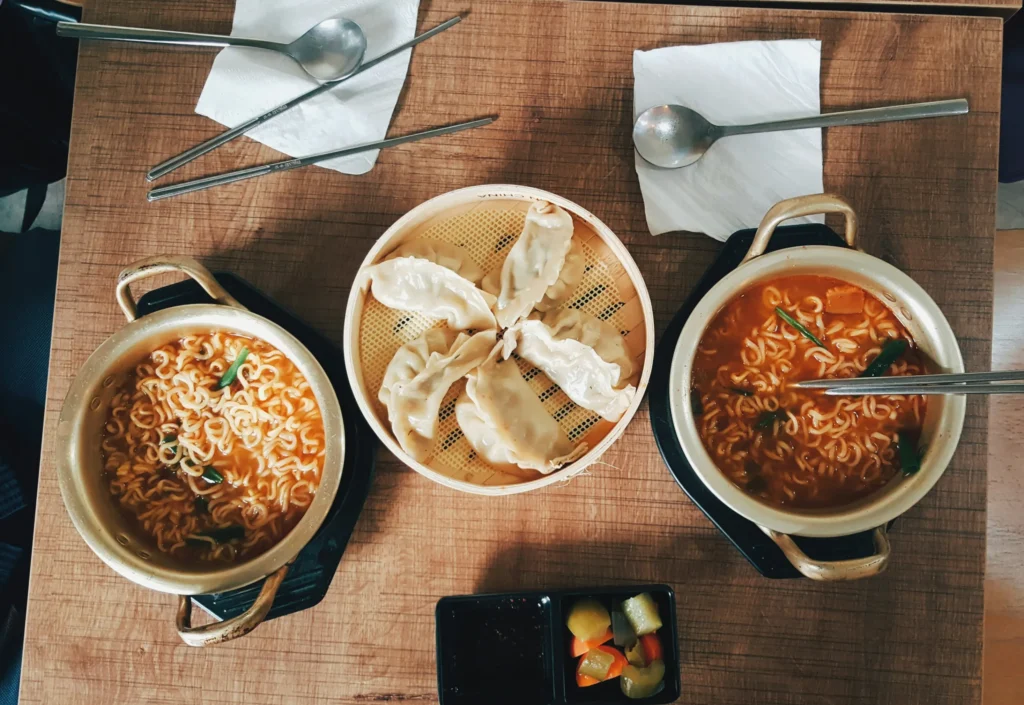
Seoul has always been one of the most romantic cities to me. No, it’s not because I’ve spent countless nights watching their dramas, which typically always end up with me craving ramyeon or someone, or ramyeon with someone.
Some of my intrigue came from the way this piece visualized a little slice-of-life in the city, https://tomintransit.mystrikingly.com/blog/seoul-k-business-k-culture-between-meetings.
More importantly, being romanced by Seoul has a lot to do with how the city is constantly reminding you that you are exactly where you are meant to be.
It’s fate, or as it’s called here, in-yun.
A halmeoni from my visit to Gwangjang Market had told me about it. As she served me her infamous Kalguksu, she was elbows-deep into cutting dozens of sundae, blood sausages. While I was well aware of the market’s reputation for being one of the top places to explore after dark in Seoul, I felt bad about taking my time, so I slurped my noodles rapidly, shoving a radish mid-bite into my kalguksu.
Halmeoni looked at me for a moment. I bit off the noodles and while chewing, I uttered in the simplest way, “Sorry, will be done in a bit.”
She shook her head and waved a hand at me. “Don’t mind. Leave now. Leave later. Do whatever. It’s all set anyway.”
I stopped chewing and just stared at her, confused, my mouth filled with food. She laughed, but returned to chopping the sausages whilst talking.
“Ya, aegi, we call that in-yun, invisible connections among people in lifetimes. A man might eventually sit next to you if you stay long enough, or you could bump into a woman if you stand up to leave right now; it’s all a part of in-yun. So, do what you like, but at least enjoy your food.”
I did take my time finishing up those noodles.
The conversations stayed with me long after the meal, and I eventually found myself down the rabbit hole of looking up the concept. In-yun, 인연, is rooted in Buddhist ideas about reincarnation and karmic affinity. It basically instills in us that we share connections with many individuals in our lives, some that we know for our whole lifetime, and some, even a stranger we lock eyes with at a grocery store.
They say that when two people get married, it means they have shared 8,000 layers of In-Yun over 8,000 lifetimes.
That, alone, made me realize how much I want to keep coming back here.
Well, here I am, eating my little gimbap with a torn piece of tinfoil, watching students tilt their heads back and laugh as they take turns eating rice cakes.
Maybe it’s a bit too obsessive to make myself see these connections, but after all, I clearly am meant to go around the world looking at the beauty this little life has come to show me.
So I’ll keep returning.
I’ll watch over the couples eating their ramyeon on picnic blankets and benches on the Han River.
I’ll listen in on the drunken conversations between tired corporate slaves as they down shots of soju at a pocha.
While fate may not have destined me to reside permanently in Seoul for 8,000 lifetimes, I feel just as captivated by its beautiful places, food, and people. That is worth at least 7,999 layers.