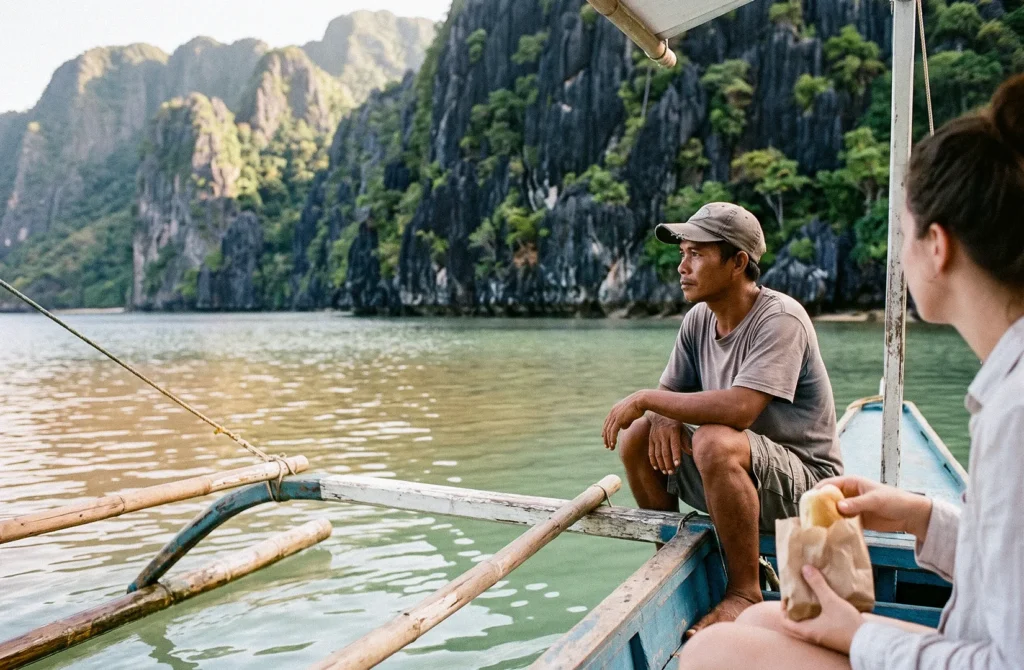
At six in the morning, Bacuit Bay in Palawan was the color of weak tea turning green. The outrigger’s engine coughed, then settled into a low hum. Water slapped softly against the bamboo arms on either side. The air was already warm, the kind of warm that rests on your shoulders like a hand.
Limestone cliffs rose out of the sea ahead of us, grey and black and furred with green. The light kept shifting across them. Pale, then gold, then something close to rose.
My guide was named Rodel. He had met me on the beach with a nod, a paper bag of pandesal, and very few words.
“Here,” he said, handing me one. Then he turned to face the water and said nothing for a long time.
I’ll admit I didn’t know what to do with that.
I’m used to guides who talk. Who fill the air with dates and names and jokes they’ve told a hundred times. I waited for the commentary. I asked a small question about the cliffs. He answered in one sentence, then went quiet again.
At first I wondered if I’d done something wrong. Then I wondered if he was tired. Then I stopped wondering and started watching him.
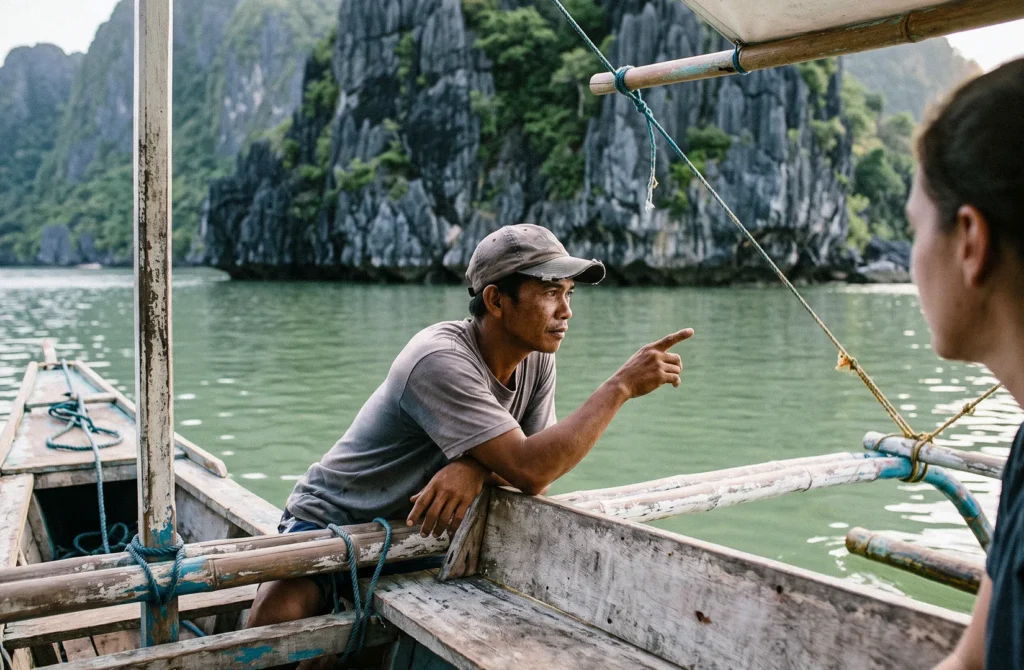
He was looking. Really looking. When the boat slowed near a lagoon entrance, he leaned forward on his elbows, eyes narrowed against the glare, as if memorizing something. When a kingfisher flashed blue across the rocks, he lifted one finger to point, and smiled to himself after it was gone.
The bread was still warm. I ate it slowly.
Near the second lagoon, he cut the engine. The silence that followed was enormous. Water dripping from the oar. A bird somewhere I couldn’t see.
“How many times have you been out here?” I asked.
He thought about it. “Since I was small. My father fished here.” A pause. “Maybe I have been here for thousands of time”
“And it still does that to you?” I asked.
“Does what?” he replied.
“Makes you stop talking.”
He laughed, a short, surprised sound. Then he shrugged. “It is never the same morning,” he said. “The tide is different. The light. Today the water is very clear. Last week, no. Brown, after the rain.” He trailed his fingers over the side. “If I talk too much, I miss it.”
“Do your other guests mind?”
“Some.” He grinned. “They want stories. I tell them a few. But I think the island tells better ones.”
I asked if he ever wanted to leave. He looked at the cliffs for a while before answering.
“Sometimes. Manila, maybe. My cousin is there.” Then, quieter: “But I would miss the mornings.”
We drifted. Neither of us spoke for several minutes, and for the first time, it didn’t feel like a gap.
I’ve thought about Rodel often since.
About how attention can look like silence from the outside. How I mistook his quiet for distance, when it was really a kind of presence I rarely practice. I travel to see things. I’m not sure I always look.
He wasn’t trying to teach me anything. He was simply living his morning, the way he had a thousand times before, and letting me sit inside it for a while.
There’s a generosity in that. Sharing a place without explaining it.
On the way back, the tide had turned. He pointed once more, at something I couldn’t name. A change in the color of the water, maybe. A shadow moving under the surface.
I looked where he pointed.
I’m still not sure what I was meant to see.