
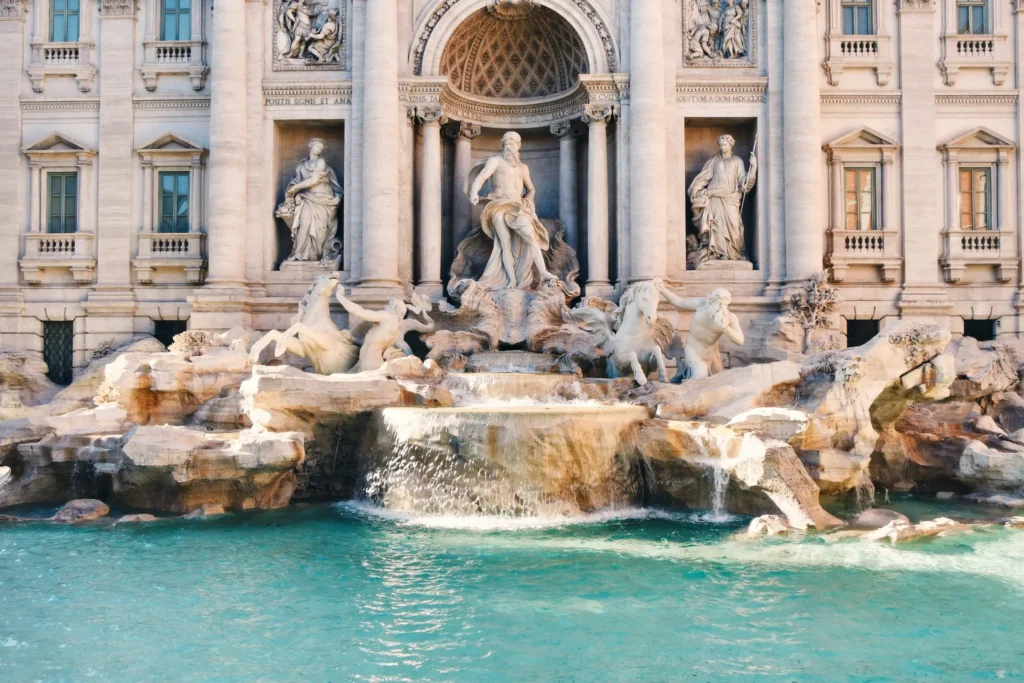
The fountain roared before I saw it.
You hear the Trevi first, a wall of water crashing over marble, loud enough to swallow the crowd. Then you round the corner and there it is, all that pale stone glowing in the late sun, sea gods frozen mid-motion, spray hanging in the air like breath. Camera shutters clicked in a hundred hands. Somewhere behind me, someone’s sunscreen and someone else’s perfume mixed into the damp warmth. I found a gap at the basin’s edge, pressed my palm flat against the cool marble, and waited my turn to be one more person throwing money at hope.
The coin had gone warm in my fist. I’d been holding it too long.
My wish was ordinary, I suppose. A safe trip. A fun one. Something romantic, maybe, the kind of thing you don’t say out loud even to yourself. And underneath all that (quieter, harder to name) I wished to find what I was looking for. I didn’t know what it was. That was the whole problem. I’d flown across the world with a restlessness I couldn’t set down, half hoping Rome would hand me an answer I’d forgotten to ask for.
I turned my back to the water, the way you’re supposed to, and let the coin go over my shoulder.
I didn’t hear it land. I told myself the fountain was too loud for that.
I’d taken maybe ten steps toward the alley when a voice cut through the noise. Sharp, insistent. A girl, thirteen, maybe, with a mess of dark curls and a white dress gone grey at the hem. She was holding something up between two fingers, saying a word I didn’t catch, then saying it again, louder, like she was used to being talked over and had decided she wouldn’t be.
My first thought was ugly. She wants my coin. I felt myself close up, protective over a wish I hadn’t even fully made.
Then I saw it. The coin in her hand was dry. It hadn’t hit the water at all, it must have bounced off the rim, skittered onto the stone. She wasn’t taking anything. She was giving it back.
Don’t ruin Rome with your own suspicion.
So I did the only decent thing. I pointed at a gelato cart down the lane and lifted my eyebrows in a question. She considered me for a long moment, weighing something, then shrugged like she was doing me the favor.
Her English came in fragments. Mine met hers halfway, in gestures, in the tilt of a head, in pointing. She was from somewhere else, that much I gathered. She watched the fountain most days. She knew which coins bounced. She said this with a small pride, then caught herself, as if pride was a thing she couldn’t afford. Between the missing words I pieced together something else: a watchfulness, a loneliness worn smooth from handling. She licked her gelato fast, guarding it.
She wasn’t sweet. She had edges. But when she laughed at something (my terrible Italian, probably) the sound was young in a way the rest of her wasn’t.
And I saw myself in her. That plain, that sudden. Someone standing at the edge of a beautiful thing, wanting to be noticed, wanting to believe the world could return what it took from you.
That was when I understood the wish had already been answered. Not by the fountain. By her.
The coin, I realized, was never a payment for luck. It was a mirror. And it had come back to me warm from another person’s hand, returned not by fate, but by a girl in a dirty white dress who owed me nothing.
She finished her gelato, nodded once, and walked off into the crowd.
I never threw the coin back in.