The diary was in a shoebox under my grandfather’s old raincoat, at the back of my parents’ hall closet.
It had a green cloth cover and a spine worn soft as felt. Inside, his handwriting leaned right, as if every sentence were in a hurry to get somewhere.
I knew that handwriting from birthday cards. I did not know it could say this.
Near the middle, one page had a folded corner. Beside the date, he had drawn a small, wobbly line falling off a flat-topped mountain.
“Angel Falls, Venezuela. Read that it drops nearly a kilometer. I would like to stand under something that doesn’t care about me at all.”
“Grandpa,” I said to the empty hallway. “Who are you?”
The man I knew fixed radios and peeled oranges in one long ribbon. This man wanted to feel small.
Four months later, I was in a small plane over Canaima National Park, my knees pressed against the seat in front.
“Unplanned” is a generous word. The idea arrived in a hallway. Everything after it took paperwork, a licensed operator, travel advisories read twice, and a guide from the local Pemón community who knew the river the way my grandfather knew circuit boards.
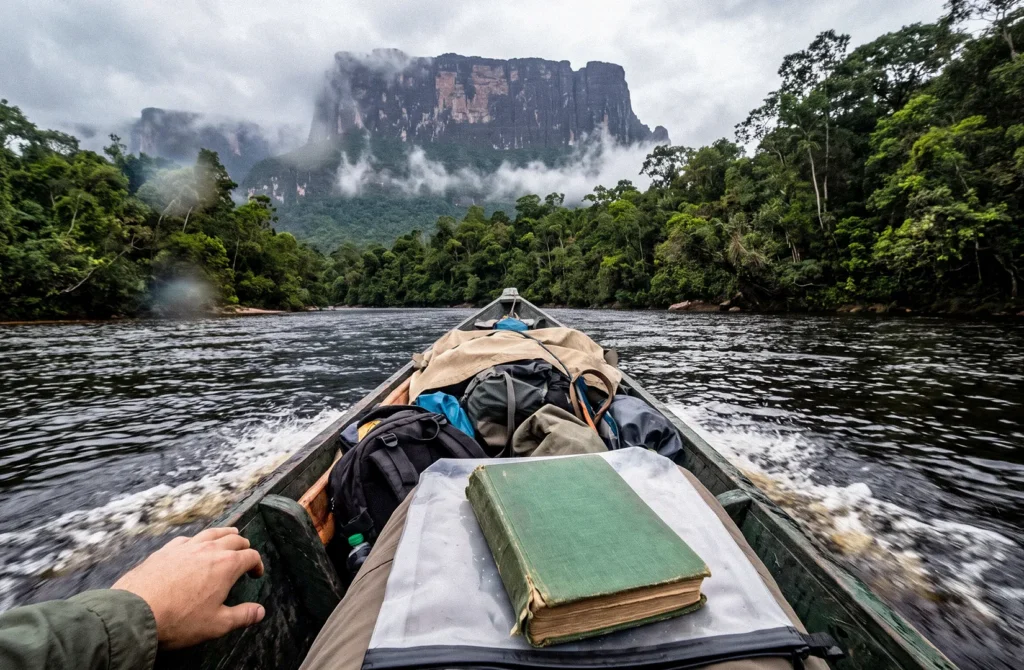
From the boat, the tepuis rose out of the forest like tables set for someone very tall. The river was the color of strong tea. I kept the diary in a dry bag on my lap, like a passenger.
“They say you go upriver by canoe. I’d probably fall out.”
“You’d be fine,” I told him under my breath. “I nearly did, though.” I added.
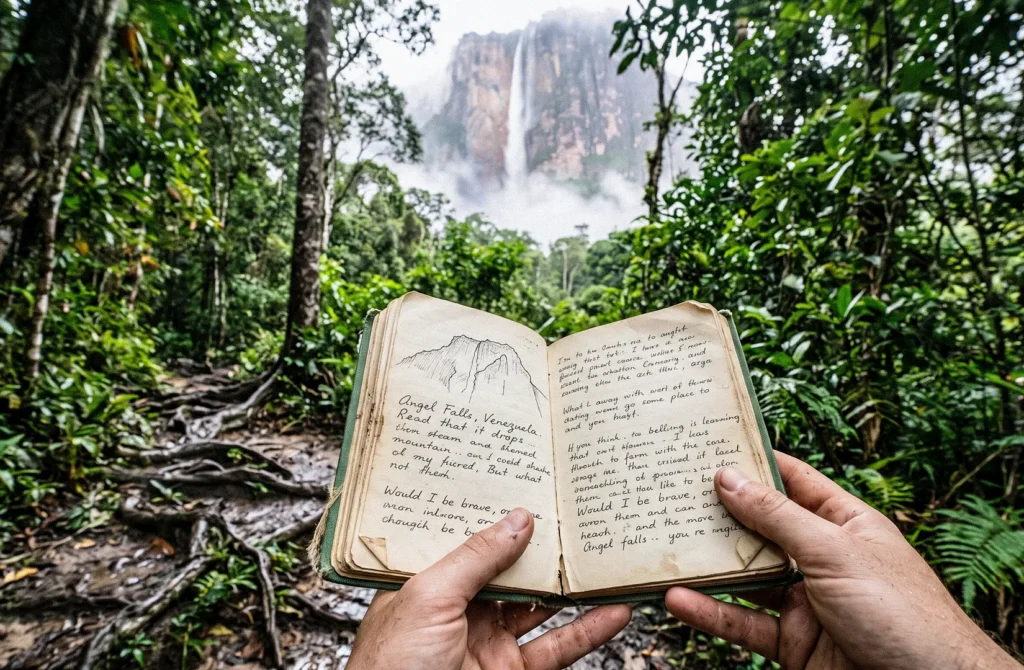
The last stretch was a walk through wet forest. The roots were slick, and my breathing was louder than I would have liked. Then the trees opened.
The water came off Auyán-tepui so far above me that it frayed into mist before it landed. The sound was less a roar than a hum, low and everywhere, settling in my chest. Spray drifted onto my arms, cool and fine. Our guide told us its Pemón name, Kerepakupai Merú. I repeated it quietly, twice, to get it right.
I opened the diary.
“Would I be brave, or would I just stand there? Probably just stand there.”
“Correct,” I said, standing there.
“Maybe next year.”
That entry was decades old. After it, nothing more about Venezuela. Just a grocery list and a note about a cousin’s wedding.
“You never came,” I said. I didn’t mean it unkindly. Life had filled his next years the way it fills everyone’s: work, children, my mother, eventually me.
I had expected to feel what he hoped to feel. Small, maybe. Unnoticed.
Instead, I felt oddly accompanied. I thought I had come for him. Standing in the mist, I realized I had also come because a sentence in his handwriting had pointed at a door I’d never noticed in myself.
He wanted to be ignored by something enormous. I think I wanted to be found by it. We are allowed to want different things from the same water.
That night in Canaima, under a tin roof ticking with rain, I turned to the first blank page after his grocery list.
I wrote the date. Then: “Stood there. Said nothing sensible. You were right.”
I could call him. He’s on the other side of the world, probably peeling an orange.
I still haven’t decided what to ask first. Why he folded that corner, or why he never unfolded it.